Flagship module · Data as at 2026H2
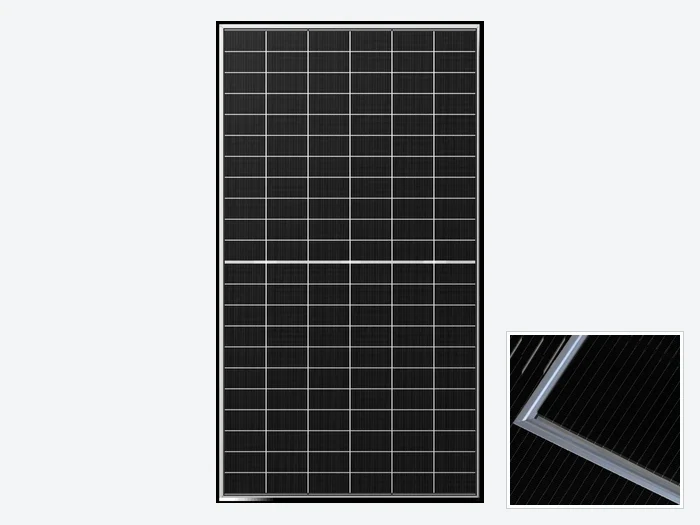
Risen Hyper-ion Ultra HJT with steel frame
Bifacial HJT large-format module RSM132-8-740-760BHDG with high-strength steel-alloy frame, approximately 3.11 m² module area – the flagship product in the AB-NETCOM system project. The full Risen portfolio for Germany and Switzerland – eight modules across three platforms – is presented in the overview below.
Module portfolio
Eight modules, three platforms
HJT Hyper-ion as the flagship product in two power classes and two frame variants, the anti-glare version for sensitive sites, and n-type TOPCon as a complement in three formats. All eight modules: 1’500 V system voltage, datasheet test load of 5’400 Pa front / 2’400 Pa rear with standard mounting.
| Module | Power | Efficiency | Dimensions | Weight | Frame | Datasheet |
|---|---|---|---|---|---|---|
| HJT Hyper-ion · Flagship product | ||||||
| Hyper-ion Ultra HJT · Steel frame RSM132-8-740-760BHDG · 132-cell HJT | 740–760 Wp | 23,8–24,5 % | 2384 × 1303 × 30 mm | 39.5 kg | High-strength alloy steel | |
| Hyper-ion Ultra HJT · aluminium frame RSM132-8-740-760BHDG · 132-cell HJT | 740–760 Wp | 23,8–24,5 % | 2384 × 1303 × 33 mm | 37.5 kg | Aluminium, silver | |
| Hyper-ion Pro HJT · steel frame RSM132-8-720-735BHDG · 132 HJT cells | 720–735 Wp | 23,2–23,7 % | 2384 × 1303 × 30 mm | 39.5 kg | High-strength alloy steel | |
| Hyper-ion Pro HJT · aluminium frame RSM132-8-720-735BHDG · 132 HJT cells | 720–735 Wp | 23,2–23,7 % | 2384 × 1303 × 33 mm | 37.5 kg | Aluminium, silver | |
| HJT Hyper-ion Anti-Glare · anti-glare | ||||||
| Hyper-ion Anti-Glare HJT · aluminium frame RSM132-8-710-730BHDG · 132 HJT cells | 710–730 Wp | 22,9–23,5 % | 2384 × 1303 × 33 mm | 37.5 kg | Aluminium, silver · anti-glare glass | |
| n-Type TOPCon · supplementary | ||||||
| n-Type TOPCon · large format RSM132-11-615-640BNDG · 132 TOPCon cells | 615–640 Wp | 22,8–23,7 % | 2382 × 1134 × 30 mm | 32.5 kg | Aluminium, silver | |
| n-Type TOPCon · roof format RSM108-11-490-515BNDG · 108 TOPCon cells | 490–515 Wp | 22,0–23,2 % | 1961 × 1134 × 30 mm | 27 kg | Aluminium, black | |
| n-Type TOPCon · compact format RSM96-11-450-475BNDG · 96 cells TOPCon | 450–475 Wp | 22,5–23,8 % | 1762 × 1134 × 30 mm | 21.5 kg | Aluminium, black | |
Source: Risen Energy, datasheets 2026H2 (HJT datasheets with status «Preliminary»; TOPCon 490–515 Wp: 2026H1). All values are manufacturer's specifications. Only the current Risen datasheet approved for the target market is binding.
Technical data
Steel frame · Datasheet 2026H2 (Preliminary)
The project focus is on 740 and 750 Wp. Only the current Risen datasheet approved for the target market is binding.
Mechanics in the system
The datasheet test load of 5’400 Pa applies to standard mounting. The system design case of 13’000 Pa (up to 15’000 Pa) refers to the system assembly comprising the module, GRP Hyperframe and mounting structure. The 39.5 kg applies to the module alone; for the GRP Hyperframe, approximately 9–10 kg per module is assumed in the development concept (system assembly approx. 49–50 kg).
| Datasheet output | 740–760 Wp |
|---|---|
| Project focus | 740 / 750 Wp |
| Module efficiency | 23,8–24,5 % |
| Bifacial output (BNPI, 135 W/m² on the rear side) | 830–852 Wp |
| Cells | 132 HJT half-cells |
| Front glass / rear glass | 2.0 mm / 2.0 mm |
| Dimensions | 2384 × 1303 × 30 mm |
| Weight | 39.5 kg |
| Frame | High-strength alloy steel |
| Temperature coefficient Pmax | −0.24 %/°C |
| Module operating range | −40 to +70 °C |
| Maximum system voltage | 1’500 V DC |
| Mechanical datasheet test load (front / rear) | 5’400 / 2’400 Pa |
| Warranty | 15 yrs product / 30 yrs performance |
| Logistics | 36 modules/pallet · 576 per 40’-HQ |
Technical source: Risen Energy, datasheet RSM132-8-740-760BHDG steel frame, version REM132-BHDG-0BB-EN-H2-1-2026-Ultra (Preliminary). The 2026H2 datasheet has the status «Preliminary». General product information: en.risen.com/assembly/hjt
Why HJT?
More yield per area – even in cold, snow and diffuse light
Heterojunction combines crystalline silicon with thin amorphous silicon layers. Four properties are important for alpine and large-scale projects.
Earlier in the morning, longer into the evening.
Risen describes good low-light performance – usable in diffuse light as well as in the morning and evening.
When temperatures rise.
−0.24 %/°C temperature coefficient Pmax: low power loss at high cell temperatures.
Energy from both sides.
Bifaciality factor 90 ± 5 % (manufacturer's specification). Light-coloured surfaces and especially snow reflect light onto the rear side of the module. The additional yield depends on the location, mounting structure, row spacing, shading and layout.
Long-term performance retention.
Manufacturer's specification: ≤ 1 % in the first year, followed by 0.3 % per year, around 90 % after 30 years. Zero Busbar (0BB) and the patented Hyper-Link cell interconnection reduce shading losses at cell level.
Site-specific manufacturer field measurement. Saudi Arabia: +3.58 % monthly yield compared with a TOPCon system used for comparison during a low-irradiance period. No yield guarantee.
n-type TOPCon as a complement. An additional module platform from the Risen portfolio for projects where the format, performance class, availability, approved mounting conditions or project-specific economics favour a TOPCon version.
Source: Risen Energy – HJT Hyper-ion. All values are manufacturer's specifications.
Anti-glare design · Hyper-ion Anti-Glare
For airports, roads, railway lines and sites close to residential areas
Risen combines a microstructured matt glass surface with an absorbing coating on the HJT cell. Incident light is scattered diffusely rather than reflected – without mirror reflections or rainbow effects.
This makes it possible to develop sites previously ruled out due to glare assessments: near airports, motorways and railway lines, and on slopes above residential areas.
| Glare assessment compared with standard module | over −80 % |
|---|---|
| Surface gloss (60°) | 6.7 GU |
| Haze / glass transmission | 89 % / 93,2 % |
| Test standard for glare assessment | T/CPIA 0119-2025 |
| Certification | TÜV Rheinland AAA |
Performance classes, formats and availability of the anti-glare version – including in combination with the steel-frame large format – are clarified with the manufacturer on a project-specific basis. All values are manufacturer's specifications.
Sources: PV Tech – Risen Hyper-ion Anti-Glare modules leading PV safety · SMM News – TÜV Rheinland AAA Certification

Large format and Balance of System
More power per module. Fewer modules in the field.
Calculation example for 20 MWp DC rated capacity: The higher the module output, the fewer modules are required for the same plant capacity – without taking project-specific design reserves into account.
What this means for large roofs
On industrial and commercial roofs, the number of installation steps per installed kilowatt is just as important as output per square metre. Large-format modules with 30-mm steel frames deliver more power per clamping point; the roof's structural engineering and the manufacturer's approved installation conditions are checked on a project-specific basis.
What this means for alpine ground-mounted plants
In mountainous areas, every transport, clamping point and connector costs more than on flat terrain. Fewer, but more powerful modules reduce helicopter and cable-car cycles, installation hours and maintenance points – provided that the module frames, system assembly and mounting system can safely withstand alpine loads. This is precisely why AB NETCOM is developing the GRP Hyperframe.
Resources and CO2
Less material, less CO2 – calculated per module.
A large proportion of a solar plant's emissions arise before the first kilowatt-hour is generated: in the frames, mounting system and cells. Calculating per module makes it possible to transfer the impact to projects of any size – from commercial roofs to alpine ground-mounted plants.
Calculated per module, valid for every project size
- Steel frame instead of aluminium: around 77 % less CO2 in the frame over its life cycle, around one third of the energy required for manufacture – around 26 kg CO2e per module (Risen manufacturer's specification).
- GRP Hyperframe instead of aluminium mounting structure: around 40 kg CO2e less per module (target value from the development concept).
- Around 65 kg CO2e in total per module. For a 20-MWp project with around 26’700 modules, this amounts to around 1’700 t CO2e solely through the frame construction.
- HJT module with certified footprint: below 376.5 kg CO2eq/kWc (Certisolis certification according to the French CRE methodology) thanks to a low-temperature process and thin cells; less than 7 mg of silver per watt.
- Hail protection saves embodied energy a second time: Each module that does not need to be replaced after a hail event avoids the manufacture, transport and disposal of a replacement module.
How to read the figures. Frame and module values are manufacturer's or certification figures. The value for the GRP Hyperframe is a target value from the development concept and is verified in the testing process . The project total is an approximate calculation based on around 26’700 modules – it does not replace project-specific life-cycle assessments.
Sources: Risen Energy – steel frame ZAM (77 %) · PV Tech – Alloy steel frame · Risen Energy – Certisolis Carbon Footprint
Downloads
Datasheets and brochure
Manufacturer documents from Risen Energy for the module platforms currently offered, as well as the AB-NETCOM brochure 2026. Only the current datasheet approved for the target market is binding.
Risen Energy datasheets (manufacturer documents)
- Hyper-ion Ultra HJT · Steel frame740–760 Wp · RSM132-8-740-760BHDG
- Hyper-ion Ultra HJT · aluminium frame740–760 Wp
- Hyper-ion Pro HJT · steel frame720–735 Wp
- Hyper-ion Pro HJT · aluminium frame720–735 Wp
- Hyper-ion Anti-Glare · anti-glare710–730 Wp
- n-Type TOPCon615–640 Wp
- n-Type TOPCon490–515 Wp
- n-Type TOPCon450–475 Wp
Product images and datasheets: © Risen Energy Co., Ltd. – use within the framework of the distribution partnership.
Your next energy project
Which module is right for your site?
In the 20-minute project check, we clarify the site, loads, grid and schedule – and whether Hyper-ion Ultra, Anti-Glare or TOPCon is the right platform.