Battery storage · commercial, industrial, grid
Storage from commercial cabinets to the 5-MWh container
Risen Energy manufactures storage systems with its own cell and module production and an annual capacity of over 15 GWh. All commercial and utility-scale storage systems of the current generation are liquid-cooled and use LFP cells (lithium iron phosphate) – the most thermally stable widely used lithium chemistry.

Commercial and industrial (C&I)
From the switchroom to the works yard: storage that makes economic sense
| System | Capacity / power | Form factor | Typical application |
|---|---|---|---|
| Risen Stack · modular | 42–120 kWh, stackable | Modular tower system, plug-and-play | Small commercial enterprises, agriculture, charging infrastructure |
| iCon 105 kW / 215 kWh | 215 kWh · 105 kW AC | All-in-one cabinet, PCS integrated, liquid-cooled | Commercial applications with peak loads, PV self-consumption |
| iCon 125 kW / 261 kWh | 261 kWh · 125 kW AC · 1.6 m² footprint | All-in-one cabinet, grid-connected or island operation | Industry, logistics, cold-storage facilities, charging parks |
| New-generation iCon | 261 kWh · 131 kW AC | SiC inverter, battery and PCS liquid-cooled | Two charge/discharge cycles per day |
| Parallel operation | several MWh | Multiple cabinets operating together, STS changeover at 200 / 500 kW | Larger sites, microgrids |
All systems listed can, on request, be operated without connection to the manufacturer’s services – control and data storage via the Swiss control layer, network segregation and remote access control included as part of the system documentation.

Technology of the 2026 iCon generation
SiC power electronics
99.1 % peak PCS efficiency, approx. 90 % system efficiency (round trip).
Dual liquid cooling for battery + PCS
Full power in hot conditions, with waste heat used to preheat the cells in cold conditions.
Protection and corrosion class
IP66 protection rating (PCS), optionally IP67 at pack level; corrosion class C4, optionally C5.
Multi-stage fire protection
Water-based, aerosol, optional pack level.
Installation in around 20 minutes
A cabinet can be installed in around 20 minutes thanks to preconfigured wiring.
Monitoring and optimisation
Cell-level condition monitoring, AI-supported dispatch optimisation.
Applications
Peak shaving
Reduce demand charges without having to upgrade the grid connection.
Self-consumption of the PV system
Shift midday surplus to evening and night-time consumption.
Tariff optimisation
Charge at low tariffs, discharge at high tariffs – automated.
Charging infrastructure
Operate fast-charging points without grid reinforcement.
Backup power and island operation
Continue supplying critical loads, with switchover in milliseconds.
Combination with photovoltaics
Commercial battery storage systems reduce peak loads and increase the self-consumption of large rooftop systems – sized based on the load profile and PV profile.
Sources (manufacturer's specifications): Risen Energy – C&I Energy Storage (iCon) · ESS News – 131 kW/261 kWh C&I Unit · Risen Energy – Battery storage · Strategic Energy Europe – Risen Storage Portfolio · Risen Energy – Energy Storage
Utility-Scale (BESS)
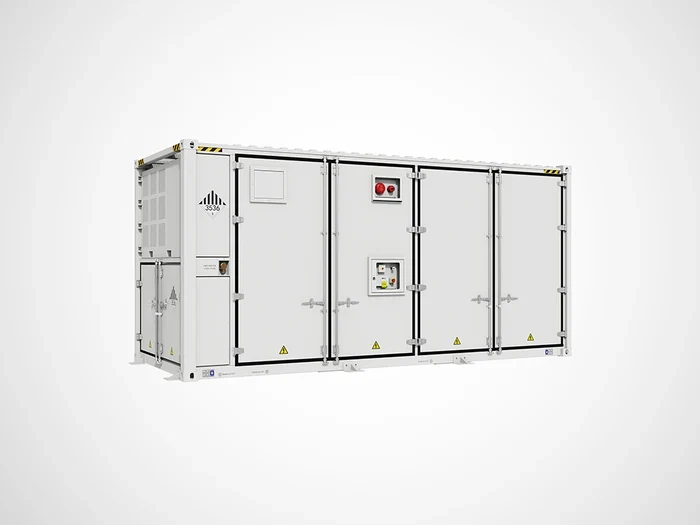
5 MWh in a 20-foot container – designed for altitudes of up to 4’000 m
For solar parks, grid nodes, industrial sites and alpine locations: containerised utility-scale storage systems from Risen Energy with liquid cooling from cell to system, multi-stage fire protection and certification in accordance with IEC safety standards for stationary storage systems. The containers are connected in parallel: plant capacities from a few MWh to several hundred MWh can be created from the same building block.
Utility-scale storage portfolio
| System | Capacity | Design |
|---|---|---|
| 836 kWh cabinet | 836 kWh | 2 h · sites, grid levels 5–6 |
| 3.79 MWh container | 3’794 kWh | 1 h · balancing energy, power applications |
| 5-MWh container | 5’016 kWh | 2 h · energy shifting, solar parks |
| eTron 3.0 Pro | 6.26 MWh | New generation, SiC-PCS 99.3 % |
5 MWh container · Model SU5016 (reference system)
| Rated capacity | 5’016 kWh |
|---|---|
| Design | 2-hour system (0.5 C) |
| Cell | LFP 314 Ah |
| Configuration / nominal voltage | 416S12P · 1’331 V DC |
| Cooling | Intelligent liquid cooling |
| Fire protection | Dry pipe, gas detection, ventilation, aerosol |
| Operating temperature | −30 to +55 °C (derating > 50 °C) |
| Maximum altitude | 4’000 m |
| Protection rating / noise level | IP55 · ≤ 80 dB(A) in 1 m |
| Dimensions (W × H × D) | 6’058 × 2’896 × 2’438 mm |
| Weight | approx. 40.3 t |
| Communications | Modbus TCP/IP |
| Standards | IEC 62619, 62477-1, 63056, 60730, 61000-6-2/-4 |
Why this matters for alpine sites
An operating altitude of up to 4’000 m and operation from −30 °C are datasheet values, not special adaptations. Liquid cooling keeps the cells within the optimum temperature range in both winter and summer – a prerequisite for service life and efficiency in mountainous regions.
Safety and experience
- Earthquake design to GR63 Zone 4 / IEEE 693, ISTA 3E transport testing
- Container walls with 2-hour fire resistance
- Liquid-cooled battery system with UL 9540A (China and USA)
- More than 400 storage projects, around 4 GWh installed; technical support for Europe from Madrid
All values are manufacturer's specifications taken from the publicly available datasheets (SU5016E2500KC datasheet, version V3.2-25-09). Market approval and grid connection conditions for Switzerland and Germany are assessed on a project-specific basis.
Sources: Risen Energy – eTron 5 MWh SU5016E2500KC datasheet (PDF) · Risen Energy – Utility-scale Energy Storage · EQS News – Risen Energy at Intersolar Europe 2026 · Strategic Energy Europe · Risen Energy – Energy Storage
Operation and control
The storage system only earns money with the right control strategy
The battery, inverter and enclosure are hardware. Whether a storage system is financially viable is determined by the energy management system (EMS): it decides when to charge, discharge, trade or hold back energy – and who has access to the operating data.
Data sovereignty
EMS hosted in Switzerland – optionally without remote access by the manufacturer
For utilities, grid operators and industrial companies with heightened requirements, AB NETCOM offers the control layer as a Swiss solution: operation, control and data storage entirely in Switzerland and under Swiss control, with interfaces to the grid operator and market participant. The plant has no connection to the manufacturer's cloud or remote services; no operating data is transmitted to the manufacturer. Network segmentation and access control form part of the plant documentation.
Where this is not required, the manufacturer's Risen Cloud platform with AI-supported schedule optimisation is available as an alternative. The operator makes the decision, which is documented on a project-specific basis.
Grid and system level
Use cases for utilities and grid operators
Balancing energy
Primary and secondary balancing power, prequalification with the transmission system operator via the market participant.
Energy shifting and arbitrage
Shift midday PV generation into the evening and take advantage of Day-Ahead and Intraday price differences.
Grid bottlenecks and capacity management
Limit feed-in peaks instead of expanding the grid connection; avoid curtailment.
Coupling with solar parks and alpine installations
Smooth winter electricity from the mountains over time and share the grid connection.
Black start, island operation, microgrid
Security of supply for sites, plants and remote locations.
Multiple use (stacking)
Combine multiple revenue streams in the same storage system – the EMS prioritises them.
Service and warranty
Long-term protection
Risen offers long-term service agreements (LTSA) and a cycle-based, usage-dependent warranty for large-scale storage systems. The scope, term and points of contact are defined for each project.
Role of AB NETCOM
One point of contact through to handover
Sizing the storage system based on the load profile and objective, preselection of the system, procurement, and coordination of the integrator, electrical planning and EMS partners.
The specific storage architecture depends on the power, capacity, operating mode, safety concept, grid requirements and site conditions. The complete product portfolio with approved datasheets is provided during the detailed project discussion.
Storage project
Determine the storage size from the load profile
Bring your annual consumption, load peaks and, if available, quarter-hourly data. During the project check, we clarify the objective, system size and appropriate control level.